


The leadership vacuum at the Labour Court
THE LEADERSHIP VACUUM AT THE LABOUR COURT AND THE NEED FOR URGENT ACTION
By the start of November 2026, the Labour Court will be leaderless. Current Judge President Edwin Molahlehi is due for mandatory retirement at the end of October 2026, while the deputy judge president position has been vacant since 2024. This is an unprecedented situation in the history of the court.
After interviewing two DJP candidates for four hours earlier this month, the Judicial Service Commission found neither suitable for appointment. The position will remain vacant for the third successive year. This situation raises serious questions about the viability of the Labour Court, a vital cog in South Africa’s justice system whose functioning has serious implications for employment and the economy.
The Labour Court is a specialist court tasked with resolving labour disputes efficiently and effectively and ensuring labour peace. Established by the Labour Relations Act of 1995, the Labour Court has equivalent status to the High Court but a narrower, specialist scope.
It receives most of its cases as reviews of arbitration awards from the CCMA (Commission for Conciliation, Mediation and Arbitration) and industry bargaining councils. However, the court also hears some trials and applications. Appeals against Labour Court decisions go to the Labour Appeal Court and ultimately end at the Constitutional Court.
According to the Judiciary Annual Report 2024/25, the Labour Court finalised 2 057 of the 3 178 cases on its rolls, which is slightly lower than the 2,587 (of 4,278) cases finalised the year before, but much higher than the 287 of 427 cases finalised in 2017/18, when statistics were first published in the Judiciary Annual Report.
Despite this increase in caseload, the number of judges at the court has not increased.
Despite this increase in caseload, the number of judges at the court has not increased. Since 2011, the Labour Court has had only 13 permanent judges spread across four cities (Johannesburg, Cape Town, Durban and Gqeberha) to serve all nine provinces. A proposal to increase the judicial complement to 20 seems to be gathering dust in NEDLAC and government bureaucracy.
This forces the court to rely heavily on acting judges, many of whom use pro bono hours to do this. This has serious implications for the court’s efficiency in discharging its functions. Indeed, the Labour Court is known for delays. The latest reserved judgments report (Term 2, 2026) shows the Labour Court with the highest number of judgments outstanding for six months or longer (163 of 445 cases). At 20% (or 89 of 445 cases), the Johannesburg node of the Labour Court has the highest percentage of outstanding judgments across all superior courts.
The latest reserved judgments report (Term 2, 2026) shows the Labour Court with the highest number of judgments outstanding for six months or longer (163 of 445 cases). At 20% (or 89 of 445 cases), the Johannesburg node of the Labour Court has the highest percentage of outstanding judgments across all superior courts.
The strain on judicial capacity at the Labour Court will only be compounded by the lack of permanent leadership at the top. Included in the 13 judges are the judge president and their deputy. They also serve a dual role as the head and deputy head of the Labour Appeal Court, which means their capacity is split between the two courts. It also underscores the seriousness of the problem of not having permanent appointments to those roles.
The Labour Court has also lost several of its most senior judges due to transfers to other courts and retirements. Between 2022 and the end of 2027, the Labour Court will have lost more than 100 years of judicial experience.
The Labour Court has also lost several of its most senior judges due to transfers to other courts and retirements. Between 2022 and the end of 2027, the Labour Court will have lost more than 100 years of judicial experience.
In a 2023 article, Judges Matter highlighted the need for proactive action by the JSC, alongside structural reforms to boost the Labour Court’s capacity.
Back then, Judge President Waglay was due to retire, and his then deputy, now Judge President Molahlehi, was up for promotion. Even then, Judges Matter was aware that Molahlehi would retire at the end of 2026 and urged the JSC to schedule interviews for his successor well ahead of time. That these interviews were only conducted three weeks before his retirement points to a dereliction of duty at the JSC.
But there are more serious problems.
Due to a major flaw in the LRA, candidates for the leadership of the Labour Court (that is, JP and DJP) can only be drawn from current High Court judges. But at the same time, they must have labour law expertise. In some ways, it’s like searching for a unicorn: you can only build serious expertise if you are a Labour Court judge, but the statute excludes all current Labour Court judges from consideration.
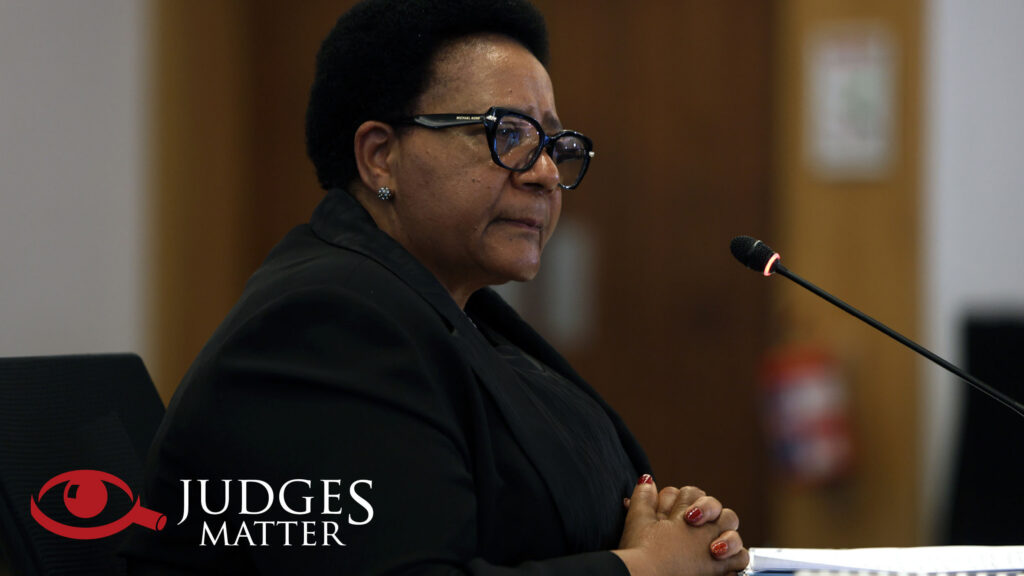
Judge B M Mahalelo during her October 2026 JSC Interview for the position of Deputy Judge President of the Labour Court and the Labour Appeal Court.
Indeed, the two judges considered for DJP by the JSC at its October 2026 sitting are both High Court judges. Judge Betty Mahalelo is a senior judge of the High Court, but her labour law expertise was only really acquired when she started acting as a judge in the Labour Court in 2023. The other candidate, Judge Graham Moshoana, was a Labour Court judge from 2017 but transferred to the High Court in 2024. This is the main reason he is eligible, but there was too little time to enable him to act and prove his judicial leadership capability. Both candidates were grilled during their interviews, but ultimately, the JSC found neither suitable for permanent appointment. So, it is back to the drawing board.
But there is hope. During his term as judge president, Molahlehi has managed to recruit a pool of younger judges with strong credentials. Two more were added at the JSC’s October 2026 sitting. This will ensure a talent pipeline for some years to come. Molahlehi also led renovations to create more courtroom space. However, there is still a desperate need for more judges. Thirteen is too few to carry the extreme caseloads of the Labour Court.
Legislative reforms are now more urgent than ever before. A simple, one-line amendment to the LRA would allow Labour Court judges to be eligible for leadership of their own court.

Judge G N Moshoana during his October 2026 JSC Interview for the position of Deputy Judge President of the Labour Court and the Labour Appeal Court.
There is also a proposal to decouple the Labour Appeal Court and re-establish it as a standalone court with its own leadership, buildings and systems to handle appeals more efficiently.
In the meantime, an acting judge president must be appointed. The JSC should immediately advertise the vacancy and prioritise interviews for its sitting in April 2027. In future, the JSC needs to play a strategic ‘human resources’ function for the judiciary by ensuring judges’ career milestones are anticipated, and vacancies are filled in advance. In the face of chronic and increasing unemployment and a fractious, fast-changing labour market, the Labour Court simply cannot afford the delay.
Mbekezeli Benjamin is a research and advocacy officer at Judges Matter, a project of the Democratic Governance and Rights Unit at UCT’s Faculty of Law that monitors the judiciary in South Africa.
No Comments