


The Eastern Cape searches for a Deputy Judge President
THE EASTERN CAPE SEARCHES FOR A DEPUTY JUDGE PRESIDENT: CHALLENGES AND CANDIDATES
After eight hours of interviews with four candidates and several hours of deliberation over two days during its October 2026 sitting, the Judicial Service Commission announced that none of the candidates was suitable for appointment. The position of deputy judge president of the Eastern Cape High Court would be left vacant. While the result was shocking, it was not entirely surprising. How did we get here, and what does it mean for the troubled court?
The candidates and the interviews
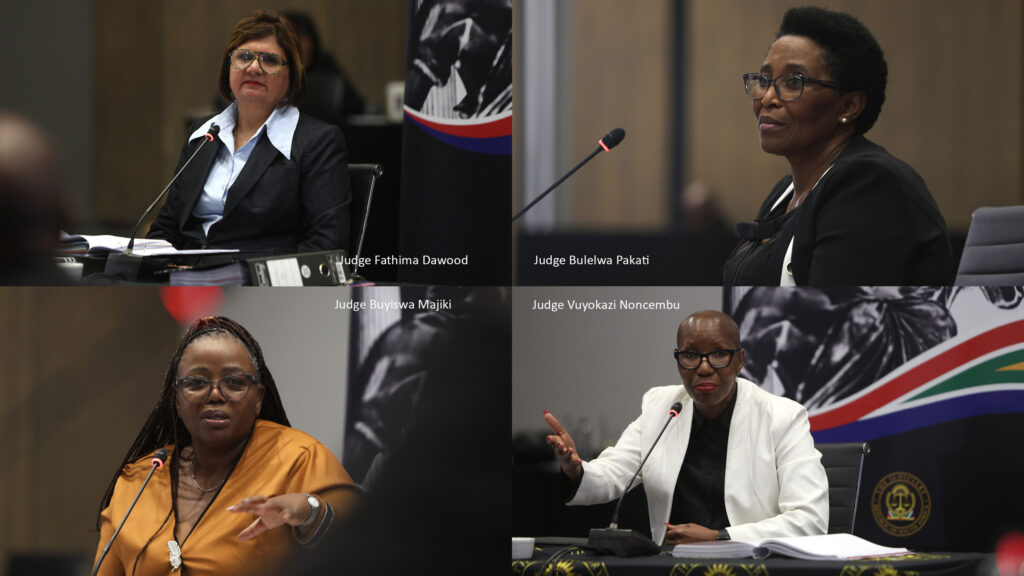
Four candidates were interviewed for the post of deputy judge president: Mthatha Judges Fathima Dawood and Buyiswa Majiki, and Gqeberha Judges Bulelwa Pakati and Vuyokazi Noncembu.
Majiki and Pakati (alongside Judge Mandela Makaula) were also unsuccessful at the October 2025 interview session, where the court’s troubles were laid bare.
With 18 years on the bench, Dawood is the most senior of all four candidates. She served as DJP and spoke confidently about the systems she had set up, but she faced an uphill battle convincing the JSC that moving from the troubled Mthatha to the more stable Gqeberha would benefit the court.
Majiki, with 16 years on the bench, served intermittently as acting deputy judge president from 2024 to 2026 but seemed unprepared for the interview. When asked to outline her vision for the court, she frantically paged through her notebook while giving sometimes incoherent responses.
With 35 years on the bench as a magistrate and later a judge, Pakati was originally appointed to the Northern Cape High Court in 2012 but transferred to her native Eastern Cape in 2020. She has been a judge in Gqeberha and acted as deputy judge president between 2024 and 2026. She devoted most of her interview to reading a prepared vision statement but did not seem to convince the JSC in follow-up questions.
Noncembu, the newest on the Eastern Cape bench, was appointed to Gqeberha in 2022 but previously headed up the regional court system in the North West province. She gave a compelling presentation of her vision, but JSC commissioner Tlaletsi raised the risk of her appointment ‘demoralising’ senior judges on a bench steeped in institutional hierarchies.
In the end, the JSC did not seem convinced by any candidate. The first round of deliberations and voting yielded no result, as no candidate secured the required 13 votes. A second round of voting and deliberations followed two days later. This followed the new selection process adopted by the JSC at the start of the October 2026 sitting. Nevertheless, no candidate won approval, and the JSC decided to leave the vacancy unfilled.
What implications does this have for the court?

Tuesday, 6 October 2026 JSC Interviews
The Eastern Cape matters for justice in South Africa
The Eastern Cape High Court is arguably one of South Africa’s most important court divisions. Covering a vast, mainly rural province, the Eastern Cape High Court attracts some of the most complex legal cases with national implications. For example, the court in Makhanda has determined two of the biggest cases involving oil exploration, national energy security, climate, and land rights (i.e., the Shell Wild Coast case and the Karoo fracking case).
In Mthatha, the court sentenced a former member of the Ngobo Seven Angels Ministeries to 241 years in prison for the mass murder of five police officers. The same court is sitting in Lusikisiki in a marathon trial of six men for the mass murder of 18 people.
Each year, the Eastern Cape High Court (sitting in Bhisho, Gqeberha, Makhanda and Mthatha) finalises over 15,000 civil cases, hears over 450 criminal trials and delivers over 630 judgments. This makes the Eastern Cape High Court an essential cog in South Africa’s judicial machinery.
Challenges facing the Eastern Cape High Court
But the court is not without its troubles. Judge President Selby Mbenenge, the most senior judge in the province, is currently facing possible judicial impeachment over sexual harassment allegations. In 2025, the court was rocked by corruption allegations about buying and selling trial dates, described as ‘court capture’. The province’s vastness and rural nature also make it difficult to access justice.
To address both corruption and access-to-justice issues, Chief Justice Maya ordered the expedited implementation of the CourtOnline system to keep court files electronic, with a digital paper trail and the ability to file from anywhere with an internet connection. Early signs suggest CourtOnline is helping, although it has not yet been rolled out universally.
The Eastern Cape courts are also under enormous strain in terms of judicial capacity. Just over 30 judges serve the vast province. Only four judges are stationed in Bhisho, and its jurisdiction has recently expanded dramatically to cover all areas from Sterkspruit on the Lesotho border to Mbashe and Port Alfred on the coast. This poses enormous challenges to the court’s ability to deal with cases efficiently.
A political hot potato is the proposal to relocate the court’s main seat from Makhanda to Bhisho, the provincial capital. Rhodes University and the Makhanda community have fiercely opposed the proposal, fearing it would decimate the local economy.
Many of these challenges were also brought to the fore during the 2025 JSC interviews, with Premier Oscar Mabuyane exclaiming at the time, “Yho, I did not know the extent of the crisis!”
All of these problems require stable, visionary and effective leadership.
The need for leadership in the courts
All of these problems require stable, visionary and effective leadership. Traditionally, the Eastern Cape High Court’s leadership is dispersed across the province: the Judge President is based in Makhanda, with one deputy judge president in Mthatha and the other in Gqeberha (also responsible for Bhisho and KuGompo).
Judge Zamani Nhlangulela currently holds the Mthatha DJP position, while the Gqeberha DJP position has been vacant since Judge David van Zyl retired in 2024.
Early in his tenure, Judge President Mbenenge sought to transform the Eastern Cape High Court. The quality of candidates attracted for appointment improved dramatically, with senior professors and top silks giving up lucrative practices to take the appointment.
Similarly, the court’s performance improved, albeit unevenly: an 84% civil case finalisation rate in 2020/21; 84% in 2021/22; 87% in 2022/23; 63% in 2023/24; and 64% in 2024/25. All but the 2023/24 performance exceeded the annual target. But all of this requires stable leadership.
The JSC must urgently advertise and fill the key DJP leadership position. But it cannot leave it there. The Eastern Cape High Court clearly needs more focused, sustained intervention to bring stability, enable access to justice, and restore public confidence in the province’s courts. The people of the Eastern Cape cannot afford anything less.
Mbekezeli Benjamin is a research and advocacy officer at Judges Matter, a project of UCT’s Faculty of Law Democratic Governance and Rights Unit that monitors the judiciary in South Africa.
No Comments