


Ramaphosa’s inaction is crippling the Constitutional Court
It is now nearly five full months since the Judicial Service Commission interviewed and recommended five judges for President Cyril Ramaphosa to select two for appointment to the Constitutional Court. The president has not yet made these appointments.
This leaves the highest court in the land to hobble along without a full complement of 11 permanent judges for the tenth year in a row. Research from the University of Cape Town shows that this is one of the causes of the court’s declining performance over the last decade. So why has the president not acted?
The president’s powers in judicial appointments
Section 174 of the Constitution gives the president important powers over the appointment of judges.
In relation to the top four judicial posts (i.e. the Chief Justice, Deputy Chief Justice, and President and Deputy President of the Supreme Court of Appeal), section 174(3) of the Constitution gives the president wide discretionary powers to initiate the process and select any suitable candidate for appointment. He only has to consult the Judicial Service Commission and leaders of political parties in Parliament.
To appoint Constitutional Court justices, the president’s discretion is narrower. In terms of section 174(4) of the Constitution, he has to select from a list prepared by the JSC. He still has to consult the leaders of parties in Parliament.
For all other judicial appointments, the president has no discretion. In terms of section 174(6) of the Constitution, he effectively signs off on a selection made by the JSC.
The last Constitutional Court interviews
The JSC concluded interviews for the Constitutional Court on 8 October 2025. A few days afterwards, they sent a list to Ramaphosa that included Judges Nambitha Dambuza, Glenn Goosen, Ashton Schippers and Kate Savage, and Advocate Alan Dodson SC. Significantly, the list included judges to be appointed to other courts as well.
Ramaphosa was meant to send the list to the leaders of political parties in Parliament for their views.
We understand that, due to the G20, he only sent it at the end of November, with a deadline of early December 2025. Since then, there has been radio silence from the Presidency on the Constitutional Court appointments.
To his credit, Ramaphosa has made appointments to the other courts – the Labour Court, and the Free State, Gauteng, KZN, Limpopo and Mpumalanga High Courts – but nothing for the apex court.
What impact has this had on the Constitutional Court?
Impact of vacancies on the Constitutional Court
Research by academics Nurina Ally and Leo Boonzaier shows that, over the period between 2010 and 2024, the Constitutional Court’s performance has been gradually declining. The court is taking longer to hear cases and deliver judgments.
In 2010, the court took an average of 104 days from hearing to judgment. In 2024, it took 214 days – over double the time. The most prominent example of this is the Phala Phala case involving Parliament’s decision not to initiate an impeachment inquiry into Ramaphosa for large sums of foreign currency found on his game farm. The case was heard on 26 November 2024. Some 450 days later, judgment is still outstanding.
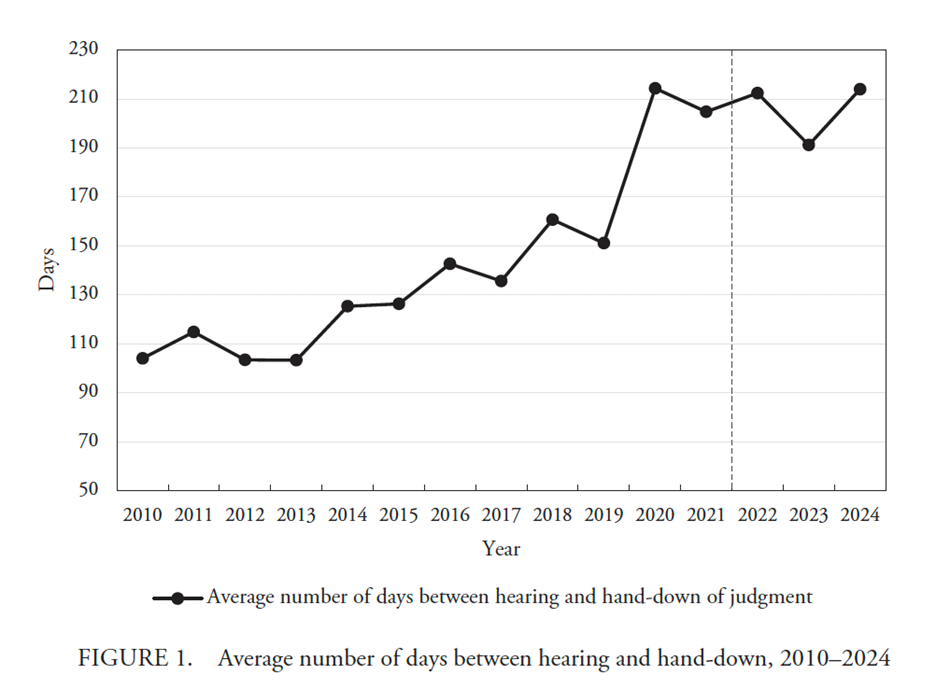
Average number of days between hearing and hand-down SA courts 2010 2024. Source: N. Ally and L. Boonzaier, The Constitutional Court’s Efficiency: An update from 2022 to 2024 –Constitutional Court Review, 2025, Volume 15, 303 – 329
The causes of the delays are varied and include an increased workload, strained judicial capacity, and the administrative and work-management systems at the court.
The increased workload is primarily caused by the Seventeenth Amendment to the Constitution in 2012, which made the Constitutional Court the apex court in all legal areas and not just constitutional law. The court received 118 new applications in 2010 versus 393 in 2021. However, the Ally-Boonzaier research also shows that since 2022, the court’s workload has been plateauing. Yet, it is taking longer than ever to complete it.
The cause of this, researchers argue, is declining judicial capacity – fewer judges doing more work.
Strained judicial capacity
Between 2010 and 2022, the court “lost” 3.3 notional permanent judges from the average case. This means that for every case, the court is relying more heavily on acting judges to maintain a quorum and hear cases. Even when accounting for judges going on long leave, the cause of this over-reliance is largely due to longstanding vacancies at the apex court.
Due to mandatory retirements, the Constitutional Court has not had a full complement of 11 permanent judges since 2016. The current two vacancies arose when Justices Mogoeng Mogoeng and Sisi Khampepe retired in 2021 and have still not been filled.
Due to mandatory retirements, the Constitutional Court has not had a full complement of 11 permanent judges since 2016. The current two vacancies arose when Justices Mogoeng Mogoeng and Sisi Khampepe retired in 2021 and have still not been filled.
This context makes the now four-month-long delay in Ramaphosa appointing judges to the Constitutional Court even more alarming.
Due to the president’s inaction, at the beginning of the court’s first term in early February, the Chief Justice and Deputy Chief Justice had to quickly scramble and draft in High Court judges Ingrid Opperman and Lister Nuku to help carry the load. This would not have been needed had Ramaphosa appointed the two new justices in January, at the latest.
The Judicial Service Commission also needs to improve
Ramaphosa does not shoulder the blame alone. The Judicial Service Commission’s notoriously poor public interviews have deterred candidates from even applying for the top job. Since 2021, the JSC has had to readvertise twice due to not attracting the bare minimum of four candidates to interview. Even when interviews have gone ahead, as in 2024, the process had to be restarted because some candidates were not suitable for appointment.
To boost confidence in its processes, the JSC needs to implement reforms like a written code of conduct for its commissioners. It also needs to adhere more closely to the criteria for judicial appointments it announced in 2023 and treat candidates with fairness and courtesy.
To boost confidence in its processes, the JSC needs to implement reforms like a written code of conduct for its commissioners. It also needs to adhere more closely to the criteria for judicial appointments it announced in 2023 and treat candidates with fairness and courtesy.
Currently, Judges Matter is doing research to track the JSC’s adherence to criteria and whether this translates into better interviews and higher-quality appointments. Anecdotal evidence suggests that since 2022, the JSC has gradually improved. But the jury is still out.
It doesn’t have to be this way
As Judges Matter has said previously, the JSC also needs to play a more strategic “human resources” function for the judiciary. Constitutional Court judges serve a fixed term of between 12 and 15 years, and are also subject to mandatory retirement at 70 years. That means from the date when a Constitutional Court judge is appointed, the JSC is able to anticipate the exact date of their departure. It should therefore be easy for the JSC to initiate the recruitment process and fill the vacancy before it even arises, like any good HR department would. Even today, we can already anticipate that at least four judges will go on mandatory retirement before Ramaphosa’s term ends in 2029. Recruitment must start in earnest.
All this said, delays in making appointments to the Constitutional Court have a direct impact on the court’s performance and public trust in the justice system. Ideally, there should be no delays at all, considering the fixed terms judges serve.
All this said, delays in making appointments to the Constitutional Court have a direct impact on the court’s performance and public trust in the justice system. Ideally, there should be no delays at all, considering the fixed terms judges serve. However, problems at the JSC, together with the president’s inaction, are causing an untenable situation. We need urgent reforms and action.
Mbekezeli Benjamin is Research and Advocacy Officer at Judges Matter, a transparency project of the Democratic Governance and Rights Unit at the University of Cape Town that monitors the South African judiciary.
A version of this article was published on News24 (2 March 2026)
No Comments