


Preview of the JSC Interviews: October 2026
New rules, old vacancies: the courts most in need are the hardest to fill
The October 2026 meeting of the Judicial Service Commission (JSC), which starts on Monday, 5 October, brings together significant judicial vacancies, serious judicial misconduct matters and proposed reforms to the JSC’s processes. Its decisions will have important implications for an independent, ethical and credible judiciary.
While much public attention is focused on the Madlanga Commission and the upcoming elections, the JSC’s decisions in the next few days also deserve our collective attention.
On the agenda are 43 candidates scheduled for 44 interviews for 22 vacancies across 11 superior courts or court groupings, judicial misconduct matters and a suite of reforms to the JSC’s processes.
On the agenda are 43 candidates scheduled for 44 interviews for 22 vacancies across 11 superior courts or court groupings, judicial misconduct matters and a suite of reforms to the JSC’s processes.
Originally scheduled for two full weeks from 5 to 16 October, the JSC meeting in Sandton, Johannesburg, has now been trimmed to just eight days (until 13 October). This is likely to accommodate the 4 November municipal elections, ahead of which the nine parliamentarians who sit on the JSC – including EFF leader Julius Malema – are busy on the campaign trail. Since 2024, Chief Justice Mandisa Maya, who chairs the JSC, has insisted that JSC members attend meetings in person instead of online.
[Download the October 2026 JSC Interview Schedule here]
These interviews come at a difficult time for the specialist courts. The labour courts now carry five vacancies, their highest vacancy rate in recent years. The Land Court vacancies are back on the agenda after no appointment was made in April, and the Electoral Court’s vacancy did not attract a single shortlisted candidate.
There is some cause for optimism. Justice Minister Mmamoloko Kubayi told the National Assembly in March that government and National Treasury had agreed to appoint 50 additional judges to build judicial capacity. Because the specialist courts are established under their own legislation, however, it remains to be seen whether, and how soon, they will share in this expansion.
Many of the faces before the JSC will be familiar. Fourteen of the 43 candidates were shortlisted or interviewed in one of the last two sittings. Vacancies at three courts are also being reconsidered because earlier rounds did not result in an appointment: the Competition Appeal Court, the Land Court and the Eastern Cape High Court Deputy Judge President position.
This speaks to how difficult some of these posts have been to fill, but it also presents an opportunity. Because commissioners are already familiar with some of these candidates’ records, they can move quickly past the CV and focus on the substantive, criteria-based questions that matter most.
[CLICK HERE TO READ THE PROFILES OF ALL THE JSC CANDIDATES]
Specialist courts under strain
Nowhere is the pressure on the judiciary felt more keenly this sitting than in the specialist courts. The labour courts are a case in point. With the Deputy Judge President post already vacant and Judge President Edwin Molahlehi set to retire this month, the court faces the prospect of being left without either of its leaders.
Nowhere is the pressure on the judiciary felt more keenly this sitting than in the specialist courts.
Two judges, Betty Mahalelo and Graham Moshoana, are vying for the deputy post. Beneath that leadership gap sit further vacancies. Two posts at the Labour Appeal Court have opened following Justice Kate Savage‘s promotion to the Constitutional Court and Justice Roland Sutherland‘s retirement, while the Labour Court’s Johannesburg and Durban seats each need a judge.
The Land Court and the Competition Appeal Court tell a similar story of posts that have proved difficult to fill. The Land Court vacancy was first withdrawn in 2025, pending the finalisation of the court’s new judicial establishment under the Land Court Act 6 of 2023, and in April this year none of the candidates interviewed were found suitable.
Three candidates now have the chance to become the first judges appointed under the court’s expanded jurisdiction. At the Competition Appeal Court, there is, somewhat ironically, no competition at all. Two candidates have been shortlisted for the two vacancies left by Judge Margaret Victor‘s retirement and the end of Justice Bashier Vally’s term, posts that remained open after the April interview round.
The Electoral Court, meanwhile, could not shortlist a single candidate for its vacancy for a non-judge member. With local government elections approaching and electoral disputes so often urgent and contentious, this is a concern.
The Electoral Court, meanwhile, could not shortlist a single candidate for its vacancy for a non-judge member. With local government elections approaching and electoral disputes so often urgent and contentious, this is a concern. The court’s President retires in December 2027. With previous rounds drawing few candidates, succession planning cannot wait.
Across the specialist courts, the pool of candidates is thinnest precisely where it most needs to be deep. Growing it is a responsibility the legal profession and the judiciary share.
Marathon round of interviews for new judges
Beyond the specialist courts, the JSC will run a marathon round of interviews for vacancies at the Supreme Court of Appeal and in the Eastern Cape, Western Cape, Gauteng, KwaZulu-Natal and Northern Cape High Court divisions. Most of these vacancies are due to natural attrition – retirements, promotions and even a death.
Four of the five candidates shortlisted for three vacancies on the Supreme Court of Appeal have been interviewed for that court in the last three years. In 2023, Northern Cape Deputy Judge President Violet Phatshoane faced a hostile JSC interview for being ‘over-ambitious’ for seeking promotion to the SCA only two years after appointment to the DJP position.
Judges Gerald Bloem and Esther Steyn were pipped at the post in a highly competitive April 2026 JSC meeting. Judge Mokgere Masipa, interviewed for the SCA in October 2025, also returns. The only candidate who has not previously been interviewed for the SCA – Gauteng High Court Judge Ingrid Opperman – was shortlisted for the Constitutional Court in 2025 but withdrew days before the interviews.
The SCA is currently buckling under the weight of a heavy caseload and is facing criticism for taking too long to both hear and adjudicate appeals. The JSC can ill afford to leave the vacancies open.
Four candidates are vying for the Deputy Judge President position at the troubled Eastern Cape High Court. Two of them, Judges Buyiswa Majiki and Bulelwa Pakati, were interviewed in October 2025 in a session where the troubles in the court were laid bare. The JSC found none of the three candidates interviewed at that sitting appointable. Will the two other candidates persuade the JSC to reach a different conclusion this time?
Eight candidates will compete for three vacancies in the Western Cape High Court, and five of them return after standing in April. That so many are willing to try again speaks to the renewed appeal of a previously troubled court that now seems to be on the up.
This is also reflected in the calibre and variety of the shortlist: two candidates hold PhDs, including UWC law professor Fareed Moosa. Three are senior counsel, including respected tax silk Michael Janisch SC. The remaining three are senior magistrate Sharon Mthimunye; trailblazing attorney Elzanne Jonker; and advocate Zuko Mapoma – a former corporate executive with an MBA.
The JSC has the happy problem of trimming this list from eight to three.
The JSC must also fill four judge vacancies in the Gauteng High Court from a shortlist of ten candidates. Alongside these vacancies, the JSC must consider serious judicial misconduct matters involving Gauteng judges, including whether to establish judicial conduct tribunals.
In a first for South Africa’s history, Judge Portia Phahlane is currently on trial for corruption for allegedly accepting bribes worth R2 million to rule in favour of a litigant. After her arrest in November 2025, the JSC did not immediately suspend Phahlane pending a tribunal investigation. Instead, it referred her to the Judicial Conduct Committee (JCC), which, in May 2026, recommended a tribunal investigation.
Nearly a year after the arrest, the JSC must now consider the JCC’s recommendation. The published schedule allocates time on Friday, 9 October, for the JSC to consider the JCC reports concerning complaints against Judge Phahlane and Judge Norman Davis of the Gauteng High Court.
The JCC has also recommended tribunal investigations for Gauteng Judge Samuel Makamu, over an alleged R5,000 bribe, and for Judge Mncedisi Khumalo, for failing to deliver judgments on time. These matters are not expressly listed in the published interview schedule.
While judicial misconduct is always worrying, scrutiny now falls on the JSC to act swiftly and demonstrate that South Africa’s judicial accountability mechanisms are capable of addressing serious allegations.
Reforms to the JSC’s wild interviews: a code of ethics
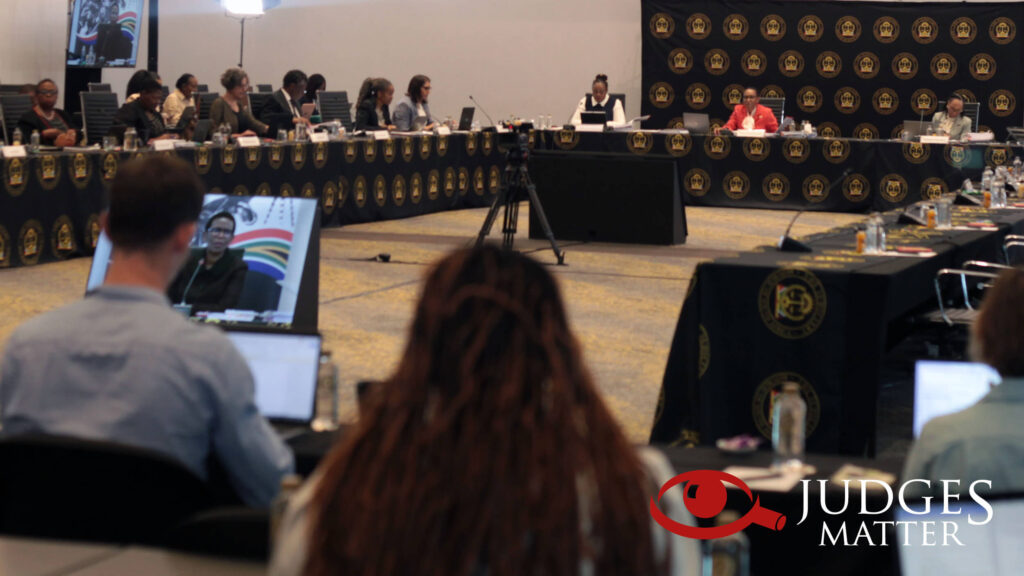
Also before the JSC are proposed reforms to how it conducts interviews. In response to trenchant criticism over many years of the JSC’s interview process, the JSC in April 2026 prepared a document to codify and revise how it conducts its business.
[CLICK HERE TO READ MORE ABOUT THE JSC PROCEDURES AND CODE OF CONDUCT]
Key proposals include a new ethics enforcement mechanism and a new voting mechanism to replace the JSC’s current system, under which vacancies can be left open even when there are suitable candidates for appointment.
Importantly, the proposed reforms also make clear that commissioners on the JSC are not free agents to behave however they please – they are bound by the ethical codes of the bodies that nominated them. For judges on the JSC, it is the Code of Judicial Conduct; for legal practitioners, it is the Code of Conduct for Legal Practitioners; MPs are bound by Parliament’s Code of Ethics, while the Minister of Justice is bound by the Executive Ethics Code.
Significantly, the new proposal would enable the JSC to request the recall of a commissioner. Where there is a reasonable basis to believe that a JSC commissioner has breached the standards expected of them during the interviews, the JSC may request that the nominating body, whether Parliament or the legal profession, remove, replace or discipline that commissioner.
In recent weeks, Julius Malema has agreed to apologise as a sanction for a 2021 complaint against him by NGO CASAC using Parliament’s Code of Ethics. The proposed JSC reforms would enable the JSC to file complaints itself against any of its commissioners.
This would give the JSC a significant mechanism to hold commissioners accountable and prevent the abusive behaviour seen in past interviews.
There’s little doubt that such behaviour has damaged the credibility of the judicial appointment process and scared some potential candidates away. Crucial courts such as the Constitutional Court and the Labour Courts have suffered longstanding vacancies.
However, Judges Matter has raised concerns that the reforms do not go far enough. Using comparative research from other countries, Judges Matter wrote a submission urging the JSC to draw up a uniform ethical code that would address any gaps, including the standards needed to hold the chair of the JSC accountable.
The JSC is under some pressure to finalise these reforms. In a settlement agreement signed with NGO Freedom Under Law in August, which is now a court order, the JSC undertook to finalise the reforms by its October meeting.
While the JSC’s proceedings have often been better known for drama and sensation, it remains a crucial body. Its decisions on the appointment and discipline of judges are essential for a strong and independent judiciary that can dispense justice speedily and effectively to all.
This sitting brings new rules and old vacancies together. If the reforms make the interview room fairer and more respectful, they may in time encourage more suitable candidates to come forward for the courts that need them most. The next few days will show whether the JSC is ready to carry the weight of that responsibility.
Mbekezeli Benjamin and Genevieve Maujean are research officers at Judges Matter, a judicial transparency project of the Democratic Governance and Rights Unit, University of Cape Town.
No Comments