


Capacity: Judge
First appointed as a judge: January 2017 (Gauteng High Court)
Gender: Female
Ethnicity: White
Date of Birth: September 1963
Qualifications: B.Comm (1985) LLB (1988) (University of Johannesburg)
Key judgments:
- South African Property Owners Association v City of Johannesburg [2024] 1 All SA 432 (GJ)
- Msunduzi Municipality v Capital City Housing NPC (823/2024) [2026] ZASCA 83 (4 June 2026)
- Saziwa v Mhlontlo Local Municipality 2026 (6) BCLR 547 (CC)
- CSARS v Bullion Star (Pty) Ltd (894/2024) [2026] ZASCA 76 (22 May 2026)
- Fuel Retailers’ Association v Minister of Energy and Others [2023] 4 All SA 739 (GJ)
- S v LM and Others (Centre for Child Law as amicus curiae) [2020] 4 All SA 249 (GJ)
Candidate Biography | Updated August 2026:
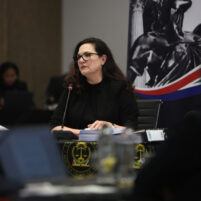
Judge Ingrid Opperman is a Judge of the Gauteng Division of the High Court.
Opperman, who hails from Hillbrow, Johannesburg, obtained an LLB from the University of Johannesburg and worked as a prosecutor for two years before being admitted to the Johannesburg Bar in 1990. She was involved in “criminal trials of a political nature arising from protest actions against the apartheid state” during that period. This changed after 1994, when her commercial practice, like many female practitioners in SA, it would appear, included more matrimonial work. Opperman was conferred silk in 2014 and acted in the High Court for various stints until her appointment to the Gauteng High Court in 2017.
She was appointed as acting judge in the Constitutional Court for three terms, two in 2025 (Dec 2024 – May 2025) and one in 2026 (Feb – March 2026). While seated at the apex court, Opperman authored two judgments: Saziwa v Mhlontlo Local Municipality and Barnard NO v National Consumer Tribunal (both 2026). During this period, Opperman has also acted in the Supreme Court of Appeal (Oct – Dec 2025) where she authored reported appeal judgments, including Msunduzi Municipality v Capital City Housing NPC and CSARS v Bullion Star (both 2026).
With no reserved judgments in the High Court, Opperman has produced over 300 judgments since 2017, 21 of which have been reported.
In Fuel Retailers’ Association v Minister of Energy and Others, Opperman considered the constitutionality of the Minister’s decision to set trading margins that force retailers to forfeit a portion of their income. This administrative law judgment reviewed, on rationality grounds, the Minister’s decision to implement the Regulatory Accounting System for the Petroleum Sector, which established a uniform retail margin for selling petroleum to end-users without providing a trading margin to compensate fuel retailers’ capital expenditure costs.
Again, in administrative law, Opperman considered a tax administration case. In Cart Blanche Marketing CC and Others v Commissioner for SARS, SARS selected the applicants for an audit to verify their compliance with the Income Tax Act and the VAT Act. Cart Blanche Marketing wanted to review and set aside the decision on the basis that it was unlawful because it was allegedly taken for an ulterior purpose and for a reason not authorised by the empowering provision. They also asserted that the decision was irrational and taken in bad faith. In considering the purpose of the Tax Act, the court concluded that selecting a person for an audit is no more than an investigative process being set in motion. This decision is significant because it clarifies that initiating an investigation does not constitute a decision capable of review, as it is not yet ripe for review.
Opperman is lauded for playing a pivotal role in protecting vulnerable groups such as women and children in her judgments. In S v LM, she dealt with the issue of young offenders testing positive for the use of cannabis on school premises and being diverted into compulsory residential care, thereby criminalising their actions. She held that this violated children’s right to dignity because it criminalises them for conduct that adults are no longer prosecuted for. Therefore, she declared the Drug Trafficking Act 140 of 1992 inconsistent with the Constitution.
In local government law, Opperman had to consider the constitutionality of the policy on development contributions to new land development in South African Property Owners Association v City of Johannesburg. The Association challenged the City of Johannesburg’s Development Contribution Policy (DC Policy) on the grounds of lawfulness, rationality, and reasonableness. The court was asked to determine the meaning of “development charge” and “development contribution” as used in the Spatial Planning and Land Use Management Act and the DC Policy. The Court held that the DC Policy raises a development contribution on a new land development based on the impact of that development on the capacity of the city’s bulk external infrastructure, and that the contribution is directly related to the new development in question. This judgment is notable for clarifying the relationship between municipalities and property developers on development charges, which affect the viability of spatial development projects nationwide.
Because she was present during the Commercial Court’s early years, she also has extensive commercial law experience in niche areas such as banking law, energy law, and tax law. As such, her judgments have attracted positive academic scrutiny. For example, her decision in Phenix Construction Technology Ltd v Hollard Insurance Company Ltd, where she discussed the fraud exception in relation to demand guarantees, was later referred to with approval in a journal article.
She is revered in legal circles for her approach to ensuring fairness to both parties involved in a matter. Most significant of these is what is now referred to as the “Opperman Method”, where she came up with a way to quantify the reserve price for attached properties.
Opperman’s proverbial pen also visited academic quarters. She has written about challenges in the adjudication process and an article titled “Common Purpose: Collegiality and Ethics in Family Law”.
She previously held the position of Chairperson of the Court of Military Appeals (July 2021).
Opperman has also devoted much of her time to mentorship and training through programmes such as the International Association of Women Judges, South Africa (SAC-IAWJ), and she has lectured for aspirant legal practitioners and served as a judicial trainer. In addition, she has worked with PABASA in training young advocates in divorces.
Although she clearly demonstrates judicial prowess in how she performs her duties as a judge, Opperman will have to show the JSC that her almost ten years on the bench provide sufficient evidence that she is the right fit for the Supreme Court of Appeal.
October 2026 Interview:
Following its interviews and deliberations, the Judicial Service Commission did not recommend Judge Opperman for appointment to the Supreme Court of Appeal.
October 2016 Interview:
October 2016 Interview:
Interview synopsis:
Asked by Chief Justice Mogoeng Mogoeng about the uneven distribution of work to female advocates, Opperman said she didn’t feel “the numbers represented” any major transformative shifts at the Johannesburg Bar where ten percent of the senior counsel were women and of that, only three percent black.
She later pinpointed that in the legal sector, there was a “group of practitioners who hold the key or access to” specialised work in fields like intellectual property rights and construction work, who are reticent to include black and female lawyers.
Asked by justice minister Michael Masutha what suggestions she had to transform the legal profession and the judiciary, Opperman said she “welcomed” initiatives by the Johannesburg Bar to ensure that a minimum of one out of every three junior counsel in a matter should be black. Opperman conceded transformation was a “very difficult matter” to deal with and that government would have to either “get corporations together and make a sanction or perhaps legislate” on the matter.
Opperman said she was “embarrassed” about not being able to speak an indigenous language.
Asked about her judicial philosophy, Opperman said hers was to “give parties a proper hearing” and to write “well reasoned judgments in a reasonable time” so as to “prevent parties from taking the law into their own hands”.