


JSC April 2026: Stronger interviews but fault lines still remain
Last week (13 May 2026), President Cyril Ramaphosa confirmed the appointment of twelve judges to positions in the Supreme Court of Appeal and the Eastern and Western Cape divisions of the High Court. These appointments are based on the recommendations of the Judicial Service Commission, which held interviews last month.
What was expected to be a rather dull Judicial Service Commission sitting in April 2026 turned out to be a week full of twists and turns. Significantly, the sitting showed strong signs of improvement in the JSC’s appointment process. Yet it also showed a need for urgent interventions and improvements, especially relating to future appointments and the conduct of commissioners.
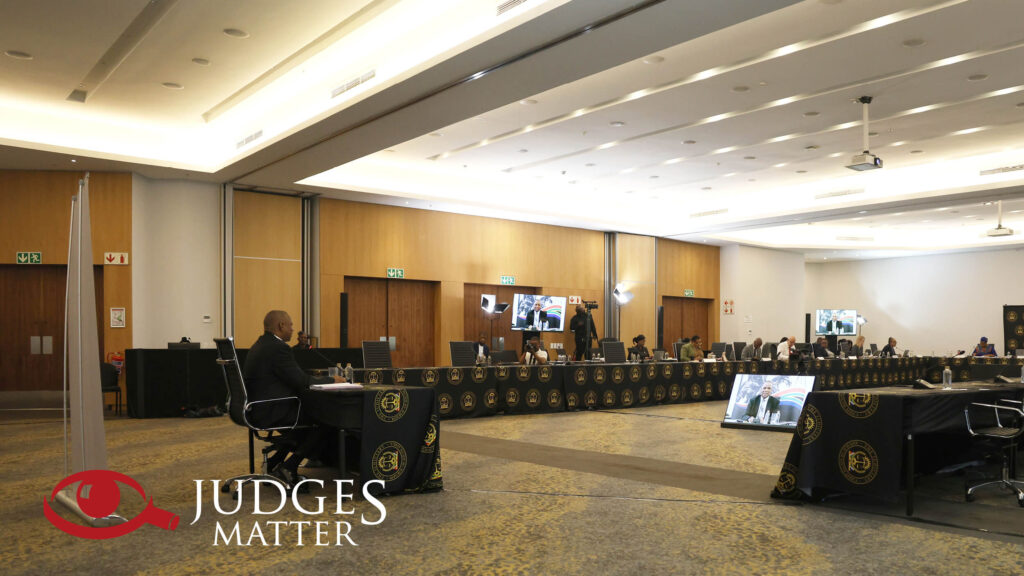
April 2026 JSC Interviews
What was expected to be a rather dull Judicial Service Commission sitting in April 2026 turned out to be a week full of twists and turns. Significantly, the sitting showed strong signs of improvement in the JSC’s appointment process. Yet it also showed a need for urgent interventions and improvements, especially relating to future appointments and the conduct of commissioners.
Supreme Court of Appeal
The JSC was spoilt for choice among the six candidates interviewed for three vacancies on the Supreme Court of Appeal. Most were senior judges with proven track records and experience. Therefore, the JSC’s task was to whittle the list down to only three. Other than KZN Judge Nkosinathi Chili, who faced tough questions over his two long-delayed judgments while acting at the SCA, all other candidates interviewed well. At the front of the JSC’s mind during the interviews must have been the SCA’s recent underperformance due to the loss of experience caused by the rapid attrition of judges over the last six years. From its ultimate selection of Gauteng Judges Bashier Vally and Leonie Windell, and Eastern Cape Judge Thandi Norman, the JSC seems to be balancing long years of experience with continuity.
From its ultimate selection… the JSC seems to be balancing long years of experience with continuity.
Vally has 14 years of judicial experience, with strong exposure to commercial law, which the SCA needs. He will serve for three years until his mandatory retirement in 2029. In contrast, both Windell and Norman represent the next generation of SCA justices and will both serve for at least a decade before retiring. Windell brings 33 years of judicial experience, 13 of which were at the High Court, along with proven expertise in tax and private law. While Norman has only been a judge for three years, she has 38 years of legal experience, including in the niche area of shipping law, which impressed the JSC. Norman starts at the SCA on 1 May 2026, while Vally and Windell start on 1 June 2026.
The Eastern Cape High Court
Nine candidates were interviewed for three vacancies in the Eastern Cape High Court. The candidates had an impressive mix of diverse experience (law professors, magistrates, attorneys, and advocates). In the end, an all-woman list made the cut: Magistrate Nolubabalo Cengani-Mbakaza, Advocate Sally Collett, and Professor Nomthandazo Ntlama-Makhanya. Cengani-Mbakaza will start in the Mthatha High Court on 1 July 2026, while the latter two will be at the Makhanda High Court, with Collett starting on 1 July 2026 and Ntlama-Makhanya on 1 August 2026.
The Eastern Cape interviews were not without drama. After half a day of interviews, it was discovered that Acting Judge President Zamani Nhlangulela should not have participated, as he had what the JSC described as a ‘conflict of interest’. We later learned that this was related to a misconduct complaint filed by one of the candidates, currently pending before the Judicial Conduct Committee. This ‘contamination’ of the interviews resulted in some of the candidates having to be flown back to Joburg to redo the interviews.
Alongside the interviews, the JSC also dealt with misconduct. In a dramatic twist, the JSC overturned the Judicial Conduct Tribunal ruling and found Judge President Selby Mbenenge guilty of gross misconduct relating to sexual harassment. The JSC also referred his case to Parliament for impeachment and possible removal from judicial office.
The Western Cape High Court
The JSC also struggled to choose from several good candidates for the five Western Cape High Court vacancies. Due to a mishap with the earlier interviews for the Eastern Cape, the Western Cape interviews started late on Thursday and ran for most of Friday, a day after several candidates should have been back in Cape Town.
In the end, the JSC chose two senior attorneys for permanent appointment: Roy Barendse and Pinda Njokweni, and three senior advocates: Diane Davis SC, Ncumisa Mayosi, and Phillipa van Zyl. This struck a careful balance between experience and youthfulness, and race and gender, as required by section 174(2) of the Constitution.
All candidates spoke glowingly of the support they received from senior judges, with one candidate speaking of a ‘sisterhood’ that welcomed her as an acting judge. This bodes well for the future of the court, as it must now rely more heavily on its new crop of judges.
The interviews also revealed the remarkable transformation currently taking place at the Western Cape High Court, which has often made the news more for scandal than for judgments. In her debut at the JSC, Judge President Nolwazi Mabindla-Boqwana asked each of the candidates about their experience of collegiality at the court. All candidates spoke glowingly of the support they received from senior judges, with one candidate speaking of a ‘sisterhood’ that welcomed her as an acting judge. This bodes well for the future of the court, as it must now rely more heavily on its new crop of judges. Since 2019, the court has lost over 220 years of judicial experience as several of its senior judges have retired, been promoted, one impeached, and one died.
The need for the JSC to play a basic ‘HR function’ for the judiciary
Collegiality and experience are crucial ingredients to the effectiveness of any court. Regrettably, the JSC has not paid sufficient attention to this factor. In many courts, the JSC has allowed the loss of massive experience through rapid retirements in a short period. In addition to the SCA and the Western Cape High Court, both the Gauteng and KZN High Courts have lost their most senior and effective judges through retirement.
Collegiality and experience are crucial ingredients to the effectiveness of any court. Regrettably, the JSC has not paid sufficient attention to this factor. In many courts, the JSC has allowed the loss of massive experience through rapid retirements in a short period.
Even though they have been replaced by senior, mature legal practitioners, this still does not make up for the judicial experience lost. This is why, in its April 2026 DGRU submission, Judges Matter strongly urged the JSC to go back to basics and play a basic ‘human resources’ function in the judiciary by carefully managing judicial talent.
Unfilled vacancies
The JSC was once again unable to fill a vacancy at the Land Court. The two candidates who applied, attorney and acting Judge Diana Mabasa and advocate Mzokhulayo Mthembu, were found unsuitable.
As with all other candidates interviewed, Mthembu was asked for his view on the new Anti-Sexual Harassment Policy for the Judiciary. Mthembu raised concerns that the policy considers that a single incident, instead of a series of incidents, may constitute sexual harassment. He further said he now understands that he needs to stop saying to his subordinates, “you look so plump in those jeans” – a joke that did not land well at the JSC, considering the efforts to combat sexual harassment in the judiciary.
While the land question is prominent in social discourse, and the need for equitable land access is so great, the JSC has historically struggled to attract candidates for the Land Court. The JSC needs a new strategy and serious intervention, because the Land Court’s now-expanded jurisdiction has led to the creation of four more judicial posts which need to be filled urgently.
The JSC needs a new strategy and serious intervention, because the Land Court’s now-expanded jurisdiction has led to the creation of four more judicial posts which need to be filled urgently.
The same is true for the Competition Appeal Court, an essential cog in the regulatory infrastructure that allows foreign direct investment in the economy. The court has had two longstanding vacancies. The sole candidate interviewed, Judge Fiona Dippenaar, was grilled on the transformation of the competition law field, which is dominated by a few large law firms and a few mainly white male advocates. The post was left vacant.
Overall, the JSC interviews for April 2026 showed an upward trajectory in how the JSC conducts the important constitutional function of selecting judges for various courts. The interviews are rigorous, yet respectful and overall dignified.
Upward trajectory of the JSC
Overall, the JSC interviews for April 2026 showed an upward trajectory in how the JSC conducts the important constitutional function of selecting judges for various courts. The interviews are rigorous, yet respectful and overall dignified. Candidates are tested on their knowledge and experience in the law, and on their integrity. This is probably thanks to the new criteria and the calibre of current commissioners. But this cannot be left to chance. This is why Judges Matter is undertaking an assessment of the JSC’s adherence to criteria and still advocates for a written Code of Conduct for Commissioners. This is all aimed at ensuring that the judicial appointment process maintains the very highest standards.
No Comments