


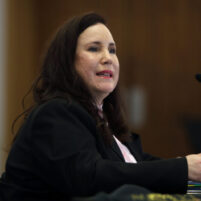
Capacity: Advocate
Admission as an advocate: 1995
Gender: Female
Ethnicity: White
Date of Birth: September 1969
Qualifications: BProc (1991) LLB (1993) (Rand Afrikaans University, now the University of Johannesburg)
Key Judgments
- Raper v Renaldo And Barrys Coins (Pty) Limited t/a R And B Coins (042752/2025; 2025/042809) [2026] ZAGPJHC 772 (10 July 2026)
- Ndebele and Another v Director General Home Affairs and Others (7155/2021) [2025] ZAGPJHC 825 (26 August 2025)
- L.M obo K.M v MEC for Health and Social Development, Gauteng (33807/2021) [2025] ZAGPJHC 1350 (10 February 2025)
- K R R v K R [2024] ZAGPPHC 900 (5 September 2024)
- R v S.R (2017/11467) [2024] ZAGPJHC 76 (24 January 2024)
Candidate Biography | Updated August 2026:
Michelle van Nieuwenhuizen is an Advocate and member of the Johannesburg Society of Advocates.
Born in Johannesburg, Van Nieuwenhuizen took her BProc (1991) and LLB (1993) at Rand Afrikaans University (now the University of Johannesburg). She began her career as a public prosecutor, appearing in the Benoni, Johannesburg and Randburg magistrates courts, including their branch courts in Soweto, Hillbrow, Alexandra and Midrand, where she gained prosecuting experience and opposed bail in serious matters.
She was admitted as an advocate in 1995 and joined the Johannesburg Society of Advocates in July 1997, where she has practised for some 29 years.
At the Bar, she built a substantial civil practice across motion and trial work, with a heavy component of urgent applications, alongside pro bono criminal appeals and bail work, and has appeared in the Gauteng, Western Cape, Limpopo and North West divisions.
She has acted as a judge of the High Court since 2023, sitting mainly in the Gauteng Local Division, Johannesburg. On her own account, she has served more than 55 weeks on the Bench, 15 of them pro bono, across the motion, urgent, family, insolvency, civil, divorce and full-bench appeal courts, and has twice been appointed for a full term.
Among the judgments she has handed down while acting is B.L.M obo K.M v MEC for Health and Social Development, Gauteng, a medical-negligence claim brought by a mother on behalf of her child, who was left with cerebral palsy after being injured at birth in a Gauteng public hospital. Van Nieuwenhuizen awarded roughly R33.3 million in damages. The case is significant for how she dealt with the state’s “public healthcare defence”, the MEC’s argument that, instead of paying a lump sum, it should be allowed to provide the child’s future medical care in kind through public facilities. She rejected the defence, finding the MEC had not shown that state hospitals could actually deliver care of comparable quality over the child’s lifetime, and ordered a monetary award.
In Ndebele v Director-General: Home Affairs, she reviewed the department’s refusal to lift the Ndebeles’ status as “prohibited persons” under the Immigration Act. She found the refusals inadequately reasoned, set them aside, and sent the matter back to Home Affairs to decide afresh within 30 days.
In K R R v K R, a family-law matter in which a couple asked the court to declare their customary marriage valid and to nullify the husband’s earlier civil marriage, she dismissed the application on the basis of lis alibi pendens (the same dispute was already before another court in pending divorce proceedings), holding that the factual disputes about the marriage should be aired in the divorce, not resolved on paper.
Notably, her range is also wide, having dealt with matters involving medical negligence, state liability, administrative review, defamation, immigration, family and commercial law. Importantly, her family and curatorship judgments suggest a keen attentiveness to children and vulnerable litigants. This focus is also clear in what Van Nieuwenhuizen views as her most meaningful contribution to the law, as she has represented vulnerable children and adults in several significant cases.
Van Nieuwenhuizen comes before the JSC as a seasoned civil and urgent-court advocate with a long pro bono acting record. The question for the JSC will be whether her breadth across so many fields translates into the settled judicial temperament the permanent Bench demands.
October 2026 JSC Interview
Following its deliberations, the JSC did not recommend Advocate van Nieuwenhuizen for appointment to the Gauteng High Court.