


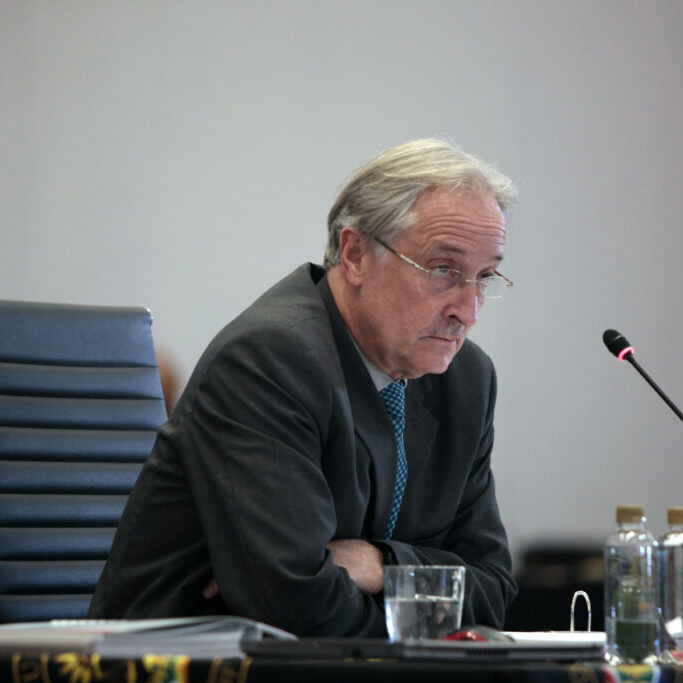
Capacity: Advocate
Admission as an advocate: August 2005
Gender: Male
Ethnicity: White
Date of Birth: June 1962
Qualifications: BLC (1988) (UP), LLB (1995), LLM (1999) (UNISA), MBA (2002) (Newport University), LLD (2025) University of Pretoria)
Key Judgments
- Mabe v Minister of Police (2019/23157) [2024] ZAGPJHC 1306 (19 December 2024)
- Merchant West Specialised Finance (Pty) Ltd v Le Grange (2023/063944) [2024] ZAGPJHC 1067 (22 October 2024)
- Oosthuizen v Association of Certified Examiners South Africa (2023/083887) [2025] ZAGPJHC 213 (6 March 2025)
- City of Johannesburg Metropolitan Municipality v Steyn (2024/025513), Gauteng Local Division, 14 August 2025
- Municipal Employees’ Pension Fund v Ndou (2025/076955) [2025] ZAGPJHC 795 (11 August 2025)
- GTG Fouries Piggery (Pty) Ltd v Maja and Others (Review) (2023/054014) [2026] ZAGPPHC 476 (17 April 2026)
Candidate Biography | Updated August 2026:
Dr Ettian Raubenheimer is an Advocate of the High Court of South Africa and a member of the Gauteng Society of Advocates.
He has had an interesting legal career to date. Before venturing into law, he obtained a national diploma in police administration through the then Department of National Education in 1987 and a BLC from the University of Pretoria in 1988. His studies continued, and he obtained his LLB and LLM from UNISA in 1995 and 1999 respectively, before being awarded a diploma in tax practice from UJ in 2000 and an MBA from Newport University in 2002.
Raubenheimer’s career depicts that of someone who is an extremely successful multitasker. He started his career as a police officer, serving for 14 years from 1982, before completing his articles of clerkship and practising as an attorney and notary at his own firm from 1998 to 2005, whilst also working as a part-time lecturer in criminal law and management science at Tshwane University of Technology.
He then completed pupillage and was admitted to the Johannesburg Society of Advocates. During this time, he also worked as a part-time lecturer in commercial law, business law, tax law and company law at UP between 2000 and 2011. He has also lectured in tax law for UJ’s postgraduate diploma since 2015. To top all of this off, he recently completed his LLD in procedural law at UP.
Adding to his expansive and diverse legal career, he served on the Tax Board from 2019 to 2023 and will serve again between 2024 and 2029.
He is also a member of various professional organisations. He has been sitting as a commissioner of the Small Claims Court in Pretoria since 2023, has served on the academic advisory committee of Stadio Higher Education and has also been a course developer and author of LLB, LLM and postgraduate modules at Stadio Higher Education since 2022. Further, he currently serves as the chairperson of the standards committee of the South African Professional Trainers Association, as a mentor to final-year UP law students, and on the disciplinary committee of the Independent Regulatory Board for Auditors (IRBA).
Raubenheimer also has publications in the legal field, such as a chapter in a 2024 book on small business management. His earlier scholarship reflects his policing background. He contributed a chapter on administrative justice to the textbook Policing and Human Rights, reviewed in the journal Obiter.
During his time as an advocate, he has appeared in some significant matters, such as Dawson v Sidney on Vaal Communal Property Association, which dealt with the socio-economic rights of land claims beneficiaries.
He has served as an acting judge of both the Pretoria and Johannesburg high courts, and of the Labour Court, across 62 weeks, beginning in November 2021, with the most recent stint being in July 2026. During his time as an acting judge, he has delivered timeous, concise and well-written judgments, which have been held in high regard by his fellow legal officers.
In Mabe v Minister of Police, the applicant sued for damages, claiming unlawful arrest and detention after being arrested at his home on 26 December 2017 and detained until 29 December 2017. The respondent’s witnesses described a police lookout for a hijacked vehicle, GPS tracking, the discovery of an abandoned vehicle, and the sighting of a black Fortuner which fled and entered the applicant’s premises. Police entered the premises without a warrant, found the applicant and goods that the complainant identified as stolen, and arrested and detained the applicant.
The issues before Raubenheimer were whether the warrantless arrest of the applicant was lawful under sections 40 and 41 of the Criminal Procedure Act, whether the police had reasonable grounds or suspicion for arresting the applicant, and whether the applicant’s detention was lawful. He noted that the only purpose for effecting an arrest without a warrant in terms of sections 40 and 41 is to bring a person to court, and that the essence of the requirement of reasonable suspicion is that an arresting officer must entertain a reasonable suspicion in respect of the commission of a specific type of crime by the person to be arrested, which suspicion must be based on factual grounds. Based on this, and on the evidence provided, he held that the arresting officers had reasonable grounds to suspect the applicant’s involvement in the offence, that the arrest complied with the legal requirements for a warrantless arrest, and that the subsequent detention was lawful due to the applicant being brought to court within the prescribed timeframe of 48 hours and a lack of evidence to establish the illegality of further detention.
In his recent judgment in GTG Fouries Piggery (Pty) Ltd v Maja and Others, GTG Fouries Piggery sought judicial review of a decision awarding it no compensation for pigs destroyed following an outbreak of African Swine Fever at its commercial farming operation. After an earlier compensation decision had been set aside administratively, the responsible authority was directed to reconsider the matter through a process aimed at reaching an acceptable settlement, but ultimately again determined the value of the compensation to be nil. Raubenheimer AJ held that the official was not entitled simply to reconsider the matter afresh while disregarding the instructions accompanying the referral and the prescribed compensation process. The court found the decision reviewable under PAJA and set it aside. The matter was remitted for a fresh determination of an acceptable compensation value, with each party ordered to pay its own costs.
Raubenheimer regards some of his most significant contributions to the legal profession as his involvement in the training of pupils, mentoring students, developing curricula to make legal education more practice-orientated and relevant, and contributing to the professionalisation of the mediation industry.
Throughout his legal career, Raubenheimer has shown versatility and great legal understanding. He has experience as an advocate in various areas of the law, and as an acting judge has heard a diverse range of civil litigation matters. He has consistently produced well-written judgments and has gone beyond the normal scope required of any legal practitioner by undertaking various leadership and public interest positions. This all points to his suitability for permanent appointment to the Bench. The question that remains is whether the JSC will agree this time around.
October 2026 Interview
Following its deliberations, the JSC did not recommend Advocate Raubenheimer for appointment to the Gauteng High Court.
October 2025 Interview
The Judicial Service Commission interviewed candidates for eight vacancies in the Gauteng Division of the High Court. Following deliberations, the Commission had resolved not to recommend Advocate Ettian Raubenheimer for the position.
Advocate Ettian Raubenheimer’s interview was unsuccessful.